
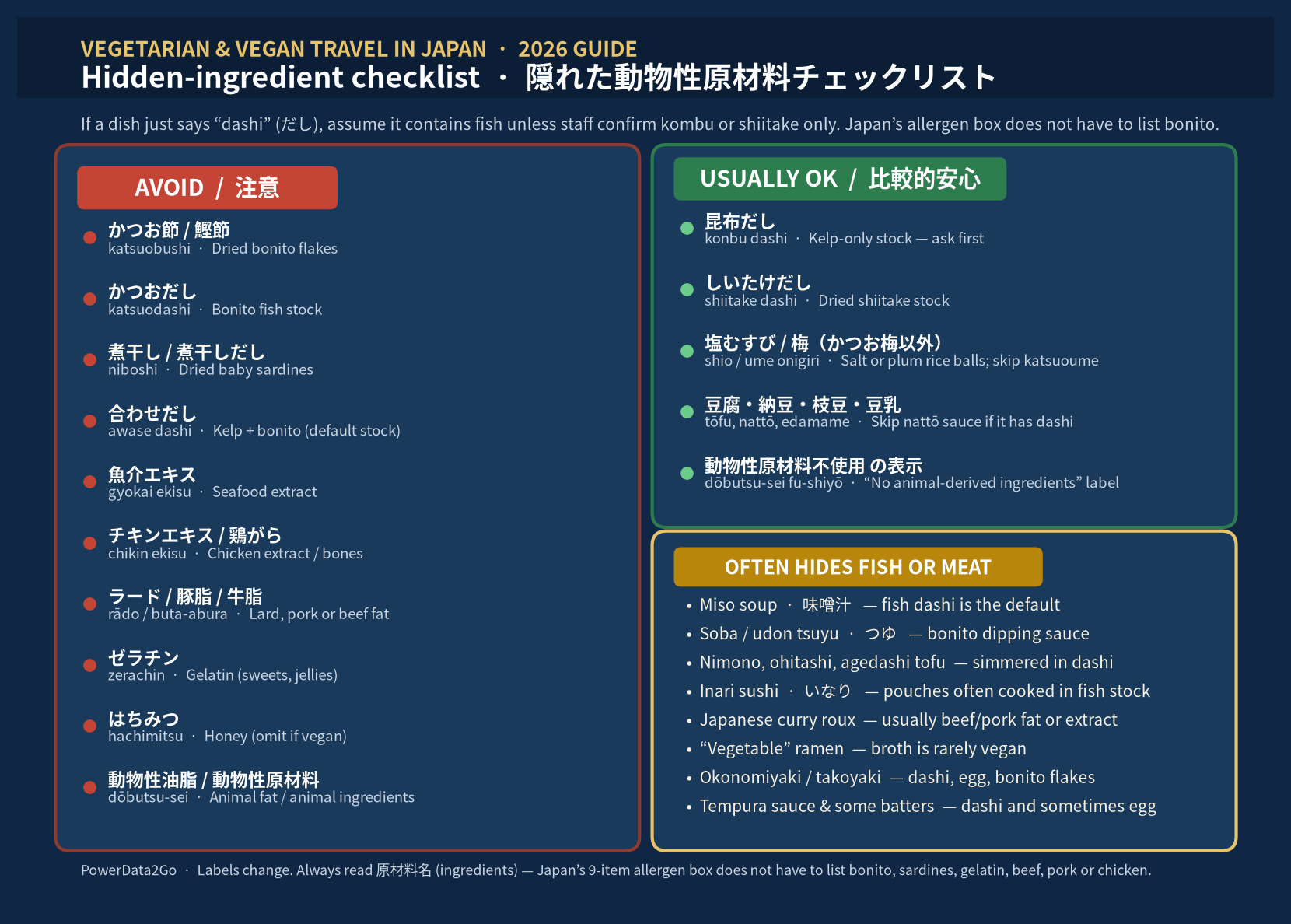
Japan is one of the most rewarding places in the world to eat — and one of the easiest to get wrong if you are vegetarian or vegan. A bowl of “vegetable” ramen, a plate of simmered greens, or a pretty tofu pouch can still be built on fish stock. This 2026 guide is written for travellers who want the honest version: what hides in ordinary Japanese food, how to say no clearly, where to eat in Tokyo, Kyoto and Osaka (only spots we could confirm on official pages), and which directories actually load and help.
Menus and hours change. Treat every restaurant name below as a starting point, then confirm on the official site or in person before you go. For live transport and weather alerts while you are on the road, our top 10 X accounts for Japan travel news is a useful companion. If you are pairing meals with a hot-spring stay, see the Tokyo onsen hotel guide and tell the ryokan about your diet when you book.
Why vegetarian travel in Japan is tricky
The core problem is dashi (出汁 / だし). In most kitchens the everyday stock is awase dashi: kelp plus katsuobushi (dried bonito flakes). Chefs often treat dashi as a seasoning, not as “fish,” so a server may sincerely tell you a dish is vegetarian because there is no visible meat. “Vegetable” on a menu is not a vegan promise.
Two other cultural points matter. First, the word “vegetarian” is imported and used more loosely than in English — chicken or fish may not count as “meat.” Second, many restaurants do not customise dishes on the fly. It is more polite, and more successful, to choose a place that already offers a plant-based menu, or to send a clear Japanese note when you reserve a set meal.
Japan’s mandatory allergen box covers only nine items (including shrimp, crab, egg, milk, wheat, buckwheat, peanuts, walnuts and cashews). Bonito, sardines, gelatin, beef, pork and chicken are not required on that box. Always read the full ingredient line, labelled 原材料名 (genzairyō-mei).
Hidden-ingredient watch list

| Watch for | Japanese | What it is | OK? |
|---|---|---|---|
| Katsuobushi / bonito flakes | かつお節・鰹節 | Smoked, dried skipjack tuna, shaved over tofu, greens, okonomiyaki | No |
| Katsuo dashi | かつおだし | Bonito stock — the default “dashi” | No |
| Niboshi | 煮干し | Dried baby sardines, used for stock | No |
| Awase dashi | 合わせだし | Kelp + bonito together | No |
| Seafood extract | 魚介エキス | Common in snacks, sauces, instant noodles | No |
| Chicken extract | チキンエキス・鶏がらスープ | Hides in ramen, gravies, some “vegetable” soups | No |
| Lard / animal fat | ラード・豚脂・牛脂・動物性油脂 | Curry roux, fried rice, some breads | No |
| Gelatin | ゼラチン | Jellies, desserts, some gummies and soft candies | No |
| Honey | はちみつ | Sweets, some sauces and dressings | No if vegan |
| Kombu dashi | 昆布だし | Kelp-only stock | Yes, if confirmed |
| Shiitake dashi | しいたけだし | Dried mushroom stock | Yes, if confirmed |
| “No animal-derived ingredients” | 動物性原材料不使用 | The most useful Japanese label on packs | Usually yes — still read the list |
Dishes that look plant-based but often are not: miso soup, soba and udon tsuyu, simmered vegetables (nimono), ohitashi, agedashi tofu, chilled tofu with flakes on top, inari pouches simmered in fish stock, most Japanese curry roux, almost all “vegetable” ramen, okonomiyaki and takoyaki (dashi, egg, flakes), and tempura dipping sauce.
Useful phrases — and a printable card
Do not stop at “I am vegetarian.” Name dashi, fish and chicken. Show a written card — staff can read it even when spoken Japanese is hard. Save the image below to your phone, or print it before you fly (it also works offline in the countryside).

| Japanese | Romaji | English |
|---|---|---|
| 私はベジタリアンです。 | Watashi wa bejitarian desu. | I am vegetarian. |
| 私はヴィーガンです。 | Watashi wa vīgan desu. | I am vegan. |
| 肉・魚・だしは食べられません。 | Niku, sakana, dashi wa taberaremasen. | I cannot eat meat, fish, or dashi (stock). |
| 卵と乳製品も食べられません。 | Tamago to nyūseihin mo taberaremasen. | I also cannot eat eggs or dairy. |
| かつおだしは入っていますか? | Katsuodashi wa haitte imasu ka? | Does this contain bonito stock? |
| 昆布だしでお願いします。 | Konbu dashi de onegai shimasu. | Please use kelp stock. |
| 動物性の材料は入っていますか? | Dōbutsu-sei no zairyō wa haitte imasu ka? | Does this contain any animal-derived ingredients? |
| 鶏肉もだめで、ゼラチンもだめで、ラードもだめです。 | Toriniku mo dame, zerachin mo dame, rādo mo dame desu. | Chicken, gelatin and lard are also not OK. |
Where to eat: Tokyo, Kyoto and Osaka
The safest strategy in cities is to mix dedicated vegan restaurants with a few confirmed chain options, and keep a konbini backup. Below are places whose official sites we loaded in November 2026. Always re-check hours and whether a branch still offers the vegetarian item.
Tokyo
- T’s Tantan — A fully vegan ramen brand (no meat, seafood, dairy or eggs), with VegeProject certification displayed at shops. Convenient station locations include Gransta Tokyo (JR Tokyo Station, B1, outside the ticket gates), Ecute Akihabara (outside the gates), Ecute Ueno (inside the gates), Ikebukuro (inside the gates), plus Narita Airport Terminal 2 and a Tokyo Food Bar outlet in Narita Terminal 1’s departure area. If a shop is inside the gates and you are not travelling, you may need a platform admission ticket. Official menu: foods.jr-cross.co.jp/ts-tantan/menu.
- AIN SOPH. — A vegan restaurant group since 2009. Official English site lists locations in Ginza, Journey Shinjuku, Soar Ikebukuro (and Kyoto and Tateshina). Menus are exclusively plant-based (no meat, fish, dairy, eggs or honey); some dishes can be made gluten-free or without the “five pungent vegetables” (garlic, onion and related alliums). Journey Shinjuku is by Tokyo Metro Shinjuku-sanchome C5. Reservations are recommended.
- CoCo Ichibanya (CoCoICHI) — Japan’s major curry chain officially sells CoCoICHI vegetarian curry (ココイチベジカレー): the company describes it as curry made without animal-derived ingredients, currently listed at ¥621 plus tax (¥683 including tax for a standard 300 g rice serving). It cannot be made “sweet / mild” (甘口). Not every branch carries it, and toppings and shared kitchen equipment vary — confirm at that shop. Official product page: ichibanya.co.jp/menu/detail.html?id=1327. Do not order the standard pork-roux curry and ask them to “just leave the meat out.”
- Official city guide: The Tokyo Metropolitan Government and Tokyo Convention & Visitors Bureau publish the TOKYO Vegan & Vegetarian Restaurant Guide 2026–2027 (English PDF; paper copies at tourist information centres). VegeProject Japan helped supervise this edition, which lists 123 restaurants in three bands: fully vegan menus, some vegan items, and some vegetarian items.
Kyoto
- AIN SOPH. Journey Kyoto — The group’s official Kyoto café, near Kawaramachi, with the same 100% vegan menu approach (pancakes, plates, burgers, desserts). Check the official page for current hours and book ahead on weekends.
- Shigetsu at Tenryu-ji — The temple’s own shojin-ryori restaurant in Arashiyama, in the World Heritage garden. Official courses (as listed in November 2026) include Yuki ¥3,800, Tsuki ¥6,500 and Hana ¥9,000, plus a ¥500 garden admission fee. Hours 11:00–14:00, closed Thursdays; reservations are required in advance (two or three days depending on the course). Tel. 075-882-9725. The Michelin Guide Kyoto Osaka 2025 named it a Bib Gourmand. This is one of the most reliable ways to try formal temple cuisine in Kyoto without staying overnight.
Osaka
- Green Earth — A long-running vegan restaurant. Official site: all dishes are made without fish, meat, eggs, dairy or chemical seasonings. Address (official English contact page): 1F, 4-2-2 Kitakyuhoji-cho, Chuo-ku, Osaka 541-0057, near the Honmachi / Shinsaibashi area. Hours: Monday–Saturday 11:30–17:00 (L.O. 16:30); closed Sundays, public holidays, Obon and New Year. Tel. 06-6251-1245.
- Paprika Shokudo Vegan — Official site describes a 100% plant-based, organic-leaning kitchen, with an English menu, and says it can accommodate customers avoiding the five pungent vegetables, as well as halal and gluten-free requests (discuss allergies with staff). Address: 1-9-9 Shinmachi, Nishi-ku, Osaka (about 5 minutes from Shinsaibashi exit 3, or 2 minutes from Yotsubashi exit 2). Lunch and dinner; closed Wednesdays. Tel. 06-6599-9788.
Konbini and supermarket survival guide
Convenience stores (7-Eleven, FamilyMart, Lawson) will save you on train days and in towns with no vegan café. They are not automatically safe. Use the camera on Google Translate, but learn the kanji above — machine translation often garbles “extract” names.
- Usually a good start: salt rice balls (塩むすび / 塩), plain pickled-plum rice balls (梅) — but skip かつお梅 (plum with bonito); edamame; cut fruit; bananas; unsweetened soy milk (調製豆乳 is sweetened/adjusted — still usually plant-based, but read the label); plain tofu; nuts; roasted sweet potatoes in season.
- Check carefully: kombu onigiri (the simmering sauce may include fish extract); inari sushi; salads with Japanese dressing; natto (the beans are vegan; the accompanying sauce often is not); “vegetable” sandwiches and pasta salads.
- Look for: 動物性原材料不使用 (“no animal-derived ingredients”), ビーガン / ヴィーガン, and third-party marks from VegeProject Japan or Vegan JAS. “Plant-based” (植物性) is used more loosely in Japan — it is not automatically vegan.
- A practical app/site: Is it Vegan? (Japan) lists thousands of packaged products (including konbini items) with a clear verdict: certified vegan, no known animal ingredients, or not vegan. Labels change, so treat it as a helper, not a substitute for reading 原材料名.
Supermarkets (Aeon, Life, Seijo Ishii, Kaldi, natural-food corners) are better for tofu, natto, rice packs, vegetables, soy milk and an increasing number of certified retort curries and snacks. If you are at a Christmas market or seasonal stall, the same dashi rules apply — see our Tokyo Christmas market 2026 guide for event context, and still ask about stock and sauces.
Shojin ryori and temple stays
Shojin ryori (精進料理) is Buddhist temple cuisine. It was designed to avoid harming animals, and traditionally uses no meat or fish, and also omits the “five pungent spices” (including garlic and onion). Soy, tofu, seaweed, sesame and seasonal mountain vegetables do the heavy lifting. JNTO notes that some modern temple kitchens may use dairy, because it is not seen as taking a life — vegans should still ask.
The classic overnight experience is a shukubo (宿坊) stay on Koyasan (Mount Koya) in Wakayama, a UNESCO-listed monastic town with dozens of temple lodgings. Meals are typically shojin ryori, often vegan-friendly, but confirm if you avoid garlic, onion, eggs or dairy. Book through the official Koyasan Shukubo Association (instant booking at selected temples such as Eko-in, Hojo-in, Fugen-in, Daien-in, Fudo-in and Kodai-in, plus a booking-request service for others). JNTO’s overview is at japan.travel/en/spot/60. In Kyoto, Shigetsu at Tenryu-ji (above) is the easiest lunchtime introduction if you are not staying at a temple.
Ryokan and hotel breakfasts
A kaiseki dinner at a ryokan is a set, often planned days ahead. Last-minute “please remove the fish” usually does not work, and can put the kitchen in an awkward position. Email your request in Japanese when you book — paste the phrase card — and ask whether they can prepare a vegetarian or vegan meal. Some inns are proud of their plant-based cooking; others will decline honestly, which is better than a hidden dashi breakfast.
Hotel buffets in big cities are easier (fruit, plain rice, salad, sometimes soy milk), but miso soup and simmered dishes still need a check. If you are choosing an onsen hotel around Tokyo, start with our onsen hotel guide and write to the property before you pay.
Certification marks, halal, and apps
Two official-looking systems now sit alongside private marks:
- Vegetarian / Vegan JAS (JAS 0025 for packaged foods, JAS 0026 for restaurants and catering) — government standards, aligned with ISO 23662. The Japan Vegetarian Society (JPVS) is a registered JAS certification body.
- VegeProject Japan — as of October 2026, its private vegan/vegetarian certification covered more than 2,000 products and menu items from over 400 companies, and is widely seen on packaging and restaurant doors. Vegan certification excludes meat, seafood, eggs, dairy and honey; vegetarian certification excludes meat and seafood. Official: vegeproject.org/en/en_certificate.
- JNTO also points to marks from the Japan Vegan Society and the Japan Vegan Certifying Society (the latter notes its symbol is introduced on JNTO’s site).
Vegan is not automatically halal. Alcohol, mirin and sake are common in otherwise plant-based dishes. Conversely, a halal meal may include meat or seafood. If you need both, say so clearly and use a halal restaurant guide such as Halal Gourmet Japan in addition to a vegan directory.
Apps and maps that help: HappyCow (directory and app), Is it Vegan? (Japan) for packaged food, Google Translate’s camera for labels, and Google Maps. On Maps, search “vegan Tokyo” (or Kyoto / Osaka), then open recent photo reviews — travellers often snap a “vegan option” sticker that a website has not updated. Many vegan cafés close between lunch and dinner, or on weekdays; always check the latest hours.
Directories and resources (verified November 2026)
Each link below loaded successfully when we checked it. We have not listed sites that timed out or returned an error, even if they are still mentioned in older guides.
| Name | Type | Best for |
|---|---|---|
| HappyCow — Japan | Directory / app | Crowd-sourced vegan and vegetarian restaurants nationwide; the most useful first map in cities |
| JNTO Vegetarian and Vegan Guide | Official tourism guide | Country overview, ordering tips, and links to certification bodies |
| TOKYO Vegan & Vegetarian Restaurant Guide 2026–2027 | Official city booklet / PDF | 123 Tokyo restaurants, split by fully vegan / some vegan / some vegetarian; also stocked at tourist information centres |
| Japan VegeMap | Map / directory | VegeProject’s nationwide map of vegan and vegan-option restaurants |
| VegeProject Japan | NPO / certification | The most widely used private vegan mark on Japanese products and menus |
| Is it Vegan? (Japan) | Product finder | Konbini and packaged foods with clear vegan / not-vegan verdicts |
| Japan Vegetarian Society (JPVS) | NPO / JAS certifier | Official Vegetarian and Vegan JAS standards and background |
| Japan Vegan Society | NPO | Certification and advocacy body listed by JNTO |
| Japan Vegan Certifying Society | Certification | Restaurant and product vegan marks; English information |
| Koyasan Shukubo Association | Official booking | Temple stays and shojin meals on Mount Koya |
| Tabelog (English) | Reviews | Japan’s major restaurant guide. A “ベジタリアンメニュー” keyword hit is not a vegan guarantee — many listings only mention vegetarian in a review. Confirm ingredients yourself. |
| Halal Gourmet Japan | Halal directory | Halal restaurants; use alongside vegan sources if you need both standards |
FAQ
Is Japan vegetarian-friendly in 2026?
In Tokyo, Kyoto and Osaka, yes — if you plan. Dedicated vegan restaurants, certified products and official city guides have grown quickly. In smaller towns you will rely more on konbini, supermarket tofu, and ryokan meals arranged in advance.
Can I eat sushi, tempura or ramen?
Sometimes, but not by default. Cucumber or takuan rolls may be fine if the rice and seaweed are plain, but inari is often cooked in fish stock. Tempura batter can contain egg, and the dipping sauce is usually dashi. “Vegetable ramen” almost always sits in a meat or fish broth unless the shop is explicitly vegan (T’s Tantan is the clear, officially vegan example).
Is shojin ryori always vegan?
Traditionally it is plant-based and also omits garlic and onion. JNTO warns that some contemporary temple kitchens use dairy. Ask: 卵と乳製品も食べられません.
Is a vegan dish automatically halal?
No. Alcohol, mirin and cooking sake are common. Halal and vegan are different standards; a dish can satisfy one and fail the other.
How do I check a konbini rice ball?
Read 原材料名. Salt (塩) is the simplest. Ume is usually fine unless it is かつお梅. Do not trust the small allergen icons alone.
Disclaimer: Menus, prices, hours and recipes change. We checked official pages and the resource URLs in November 2026, but we could not visit every kitchen. When in doubt, ask, and treat each restaurant’s own site as the last word. PowerData2Go also recommends having a Japan eSIM or portable Wi-Fi so you can load maps, translators and reservation pages on the go.